Home Hyperbaric Chamber Installation Requirements UK: Space, Power & Safety Rules Explained
Installing a hyperbaric chamber at home is technically feasible, but it comes with specific requirements around space, electricity, fire safety and compliance. Understanding these upfront will save you from costly mistakes or safety issues.
Room Dimensions and Layout
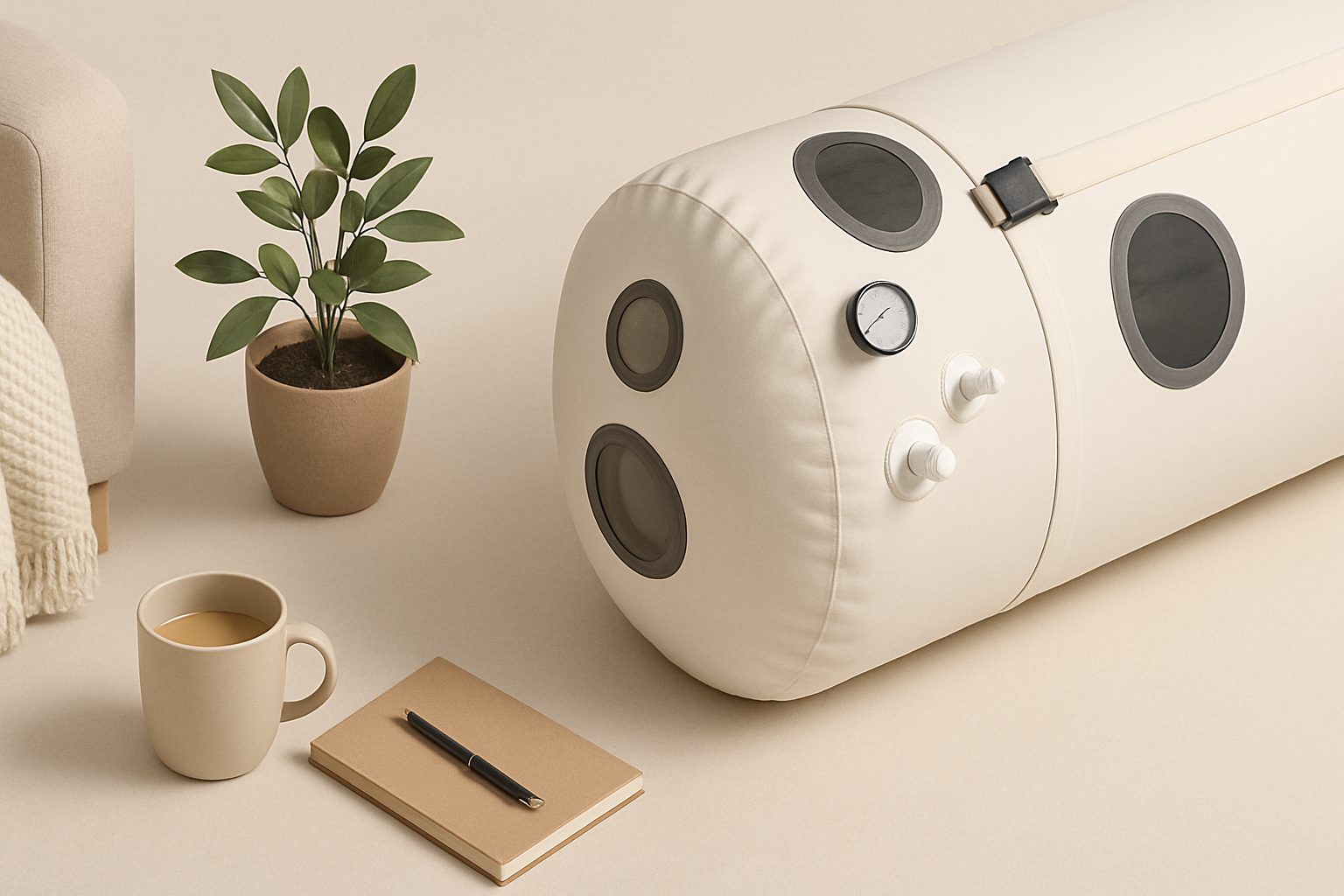
Most home-use hyperbaric chambers are either soft-sided or monoplace rigid chambers. Soft-sided chambers (the most affordable option) typically measure 2.4m long and 1.4m in diameter when inflated. You'll need a dedicated room that's at least 3m × 3m with a ceiling height of 2.2m minimum. This gives you working space around the chamber for operator access and safe movement.
Hard-sided monoplace chambers are more compact—roughly 2.1m long and 0.9m diameter—but still require similar clearance space. The critical detail most people miss is head clearance. You need at least 0.5m of free space above the chamber for safety monitoring and emergency access, plus an additional 0.5m for control panel placement and tubing connections.
The room should be dry and temperature-controlled. Hyperbaric chambers operate best between 15–25°C. Excessive heat accelerates material degradation, whilst damp environments corrode metalwork and create electrical hazards.
Electrical Supply Requirements
This is where installation gets specific and non-negotiable.
Standard 13A supply: Many compact home chambers operate on standard 13A socket power, drawing 2–3kW during operation. However, you shouldn't run this through an extension lead. The chamber must connect directly to a dedicated wall socket on a separate circuit (ideally a 32A MCB-protected circuit with its own breaker). This prevents voltage drop and potential fire risk if the circuit is shared with other high-draw appliances.
Dedicated 32A supply: Larger systems or continuous-use setups require 32A 3-phase wiring installed by a qualified electrician. This is essential if you plan regular or extended sessions. A 32A circuit provides stable power delivery and is mandatory by most insurance policies for medical-grade equipment.
You'll need a certified electrician to assess your home's consumer unit (fuse box) and determine whether you have spare capacity. Many older properties struggle here—a typical older consumer unit may have limited space or insufficient earthing. Installation costs typically range from £300–£800 depending on whether new circuits need running.
Don't attempt DIY electrical work. Your home insurer may refuse claims if the installation isn't certified, and hyperbaric chambers involve pressurised gas, making electrical safety non-negotiable.
Fire Safety and Regulatory Compliance
Hyperbaric chambers operate with compressed oxygen or oxygen-enriched air, which significantly increases fire risk. The HSE (Health and Safety Executive) doesn't mandate registration for private home use, but insurance providers do have requirements.
Fire safety essentials:
- Install a Class D fire extinguisher (suitable for metal fires) within arm's reach of the chamber. Standard extinguishers won't work effectively on pressurised oxygen fires.
- Keep oxygen concentrators (if used) at least 2 metres away from the chamber, heat sources and ignition risks.
- Ensure the room has two independent escape routes or a window suitable for emergency exit.
- Install a working smoke detector outside the chamber room.
Some insurers require the chamber to be in a room with non-combustible walls, or at least fire-rated plasterboard (30-minute fire rating minimum). Check with your specific insurer before installation.
Planning Permission and Building Regulations
Here's the good news: a hyperbaric chamber installed in an existing room doesn't require planning permission. It's not a structural change or permanent fixture (most chambers are standalone, inflatable units). However, if you're building a dedicated extension or converting an outbuilding specifically for the chamber, you will need building regulation approval.
Building Regulations Approval is worth clarifying with your Local Authority Building Control (LABC). For the chamber itself, you likely don't need sign-off if it's a commercial off-the-shelf product with CE certification. However, if you're modifying the room—adding ventilation ducting, running new electrics, or installing permanently fixed pipework for oxygen—the entire installation will need Building Regulation approval (cost typically £250–£600).
Ventilation and Atmospheric Control
Poor ventilation leads to carbon dioxide buildup and humidity problems. You need passive ventilation or active extraction if the chamber room is tightly sealed. A simple solution is a wall-mounted extraction fan (100–150mm diameter) venting to outside, running continuously during and for 30 minutes after each session.
If using bottled oxygen, ensure compressed gas cylinders are stored outside the chamber room in a well-ventilated space. Never store oxygen bottles inside the chamber or in the same sealed room.
Insurance and Inspection
Contact your buildings insurer before installation. Many standard home insurance policies exclude hyperbaric chambers entirely, or require specific clauses. Specialist insurers exist, but premiums reflect the increased risk—expect £150–£400 annually as a rider to standard cover.
Some policies require an annual inspection by a registered technician to verify correct maintenance. This is worth the cost; it protects your investment and keeps you covered in case of malfunction or incident.
Summary
Installing a home hyperbaric chamber requires dedicated space, proper electrical infrastructure, fire-safety controls, and clear insurance coverage. Budget £1,500–£3,000 for electrical work and compliance alone. Get everything certified and approved before use; cutting corners here creates serious safety and legal exposure.
More options
- Portable Hyperbaric Chambers (1.3–1.5 ATA Soft-Shell) (Amazon UK)
- 10-Litre Oxygen Concentrators for Home HBOT (Amazon UK)
- Hyperbaric Chamber Inner Liners & Comfort Accessories (Amazon UK)
- Anti-Static Floor Mats & Hyperbaric Safety Equipment (Amazon UK)
- OxyHealth & Premium Hard-Shell Hyperbaric Systems (UK Distributors via AWIN) (Amazon UK)