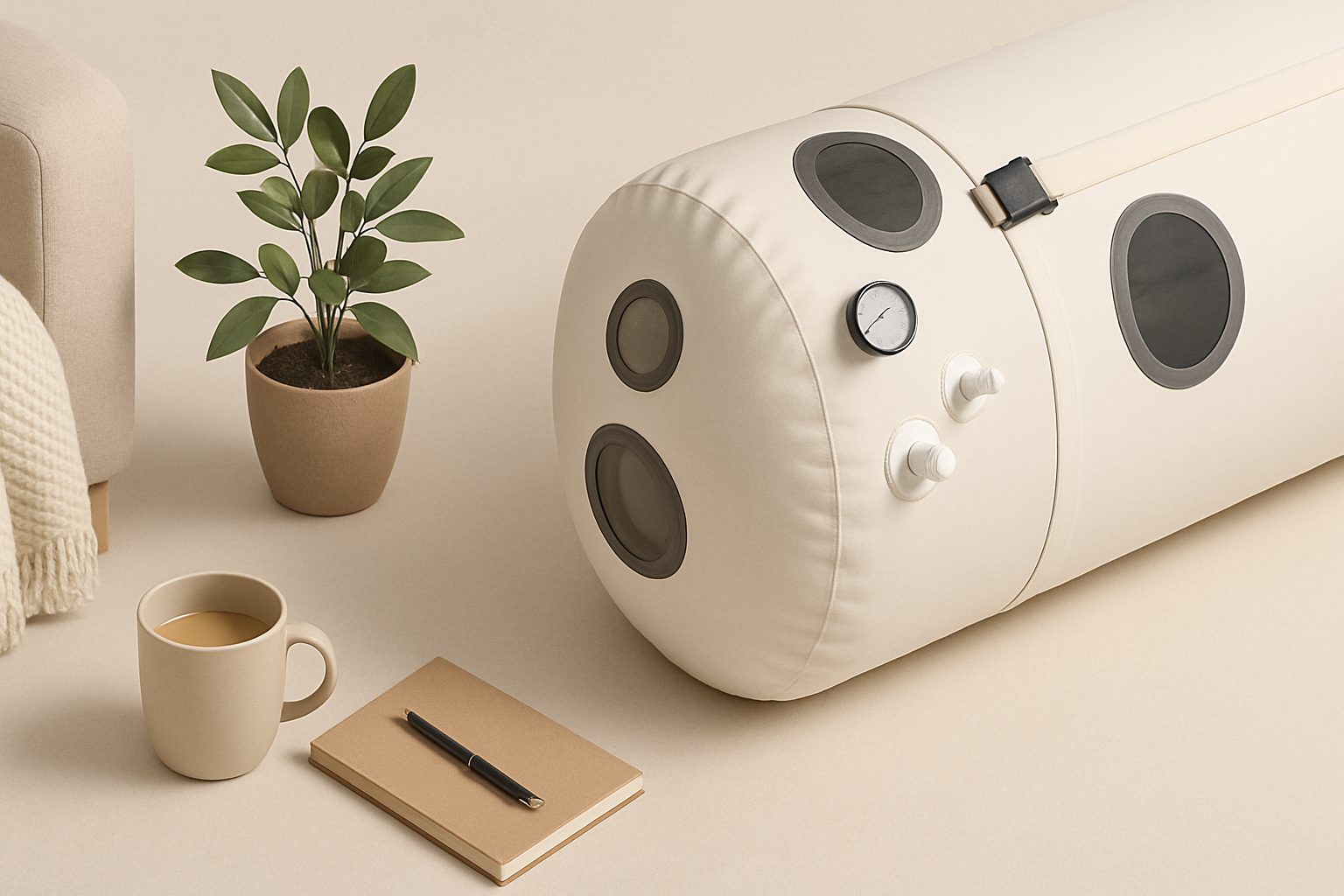
Summit to Sea Grand Dive Hyperbaric Chamber UK Review: Is It Worth the Price?
Summit to Sea's portable hyperbaric chambers have carved out a solid reputation among UK wellness enthusiasts, athletes, and recovery-focused individuals willing to invest in home equipment. But at several thousand pounds, the Grand Dive and Dive models represent a significant financial commitment. This review breaks down what you're actually getting for the money and whether it stacks up against comparable alternatives like OxyHealth.
What Summit to Sea Actually Offers
Summit to Sea manufactures soft-sided portable hyperbaric chambers designed for home use. They're considerably less expensive than hard-shell clinical models, which can cost £20,000+, and they occupy modest space. The brand focuses on the recreational and wellness market rather than clinical settings.
The range typically includes two main models in the UK: the Grand Dive and the standard Dive. Both operate at similar pressure levels (around 1.5 ATA—atmospheres absolute), which falls within the portable chamber standard, though it's worth noting this is substantially lower than medical-grade clinical chambers (which operate at 2.4–3.0 ATA).
The Grand Dive vs Dive: What's the Difference?
The Grand Dive is the larger model, offering more interior space and comfort during sessions. If you're tall or simply prefer extra room, this matters during 60-90 minute sessions. The trade-off is size and weight—it takes up more bedroom or garage space, though it's still portable by chamber standards.
The standard Dive is the compact option. It's genuinely more portable and costs less, but the tighter fit becomes noticeable on longer sessions. For most users, it's perfectly adequate; for taller users or those planning daily sessions, the Grand Dive's extra room justifies the additional expense.
Both models share the same essential mechanics: a pump generates pressure, zippers seal the chamber, and pressure gauges display current levels.
Build Quality and Practicality
Summit to Sea chambers use PVC-coated nylon, which is durable for home use but not indestructible. Zippers are the mechanical weak point—any chamber's lifespan partly depends on zip maintenance. Users report getting 3-5 years of regular use before needing repairs or replacement, which is realistic for soft-sided equipment. Hard-shell alternatives last longer but cost substantially more upfront.
Setup is straightforward. You unpack, lay it out, attach the pump, seal the zips, and run a session. No installation expertise required. The pump itself is reasonably quiet compared to older models, though it's still audible—don't expect to run sessions while on a work call.
Cleaning and maintenance is low-friction: wipe the exterior occasionally, leave zips dry, store it rolled or folded away from direct sunlight. It's not demanding equipment.
Performance and Realistic Expectations
Here's where commercial intent matters: potential buyers often research these chambers for recovery, wellness, and general stamina. That's fair context, but it's crucial to understand what science actually supports versus marketing claims.
Summit to Sea chambers operate at 1.5 ATA. This is a gentle increase in atmospheric pressure—roughly equivalent to being 5 metres underwater (though without water). Session times typically run 60–90 minutes. The sensation is a mild fullness in ears and sinuses, similar to aeroplane cabin pressure. It's not unpleasant, but it's not invisible either.
For competitive athletes, fitness enthusiasts, and recovery-focused users, these chambers are genuinely used and valued. That said, the 1.5 ATA level is on the modest end of the pressure spectrum. If you research published studies on hyperbaric therapy, most focus on higher pressures (2.4+ ATA) for specific clinical applications. At 1.5 ATA, the science is less robust—which doesn't mean it's ineffective for wellness use, but it means you're in less well-researched territory.
Head-to-Head: Summit to Sea vs OxyHealth
OxyHealth is the other mainstream soft-sided option available in the UK. Their Vitaeris and Fortius models sit in the same price bracket as Summit to Sea's offerings.
OxyHealth chambers typically operate at similar pressure levels and share comparable construction (PVC-coated nylon, pump-driven, soft-sided). The main differences are ergonomic: OxyHealth models tend to have slightly better ventilation management and a different zip configuration, which some users find more intuitive.
Price-wise, they're competitive—OxyHealth often costs 10–20% more for equivalent models, depending on where you buy. The performance gap is negligible. The real choice comes down to availability and personal preference. Summit to Sea has stronger UK distribution through specific importers; OxyHealth is easier to find online but may involve longer delivery times.
Both beat hard-shell alternatives on portability and cost. Both underperform clinical-grade chambers on pressure capacity.
Who Should Actually Buy This
This chamber makes sense if you're already interested in hyperbaric therapy and can access it affordably without travelling to a clinic. It's designed for committed home users who plan regular sessions—weekly or more—to justify the investment.
It's less suitable if you're simply curious or treating it as a one-off wellness trend. At £3,000–5,000, curiosity isn't enough justification.
The Verdict
The Grand Dive and Dive are competent, reasonably priced soft-sided chambers that do exactly what they claim. Build quality is solid for home equipment, and they're genuinely easier to own than clinical alternatives. The value proposition is straightforward: moderate pressure, accessible price, minimal maintenance.
What you're not getting is cutting-edge pressure capacity or the scientific backing of medical-grade equipment. What you are getting is practical at-home access to something that would otherwise require expensive clinic visits.
If you're researching portable hyperbaric chambers in the UK and decide this is your category, Summit to Sea is genuinely worth considering. Just don't oversell what 1.5 ATA delivers—it's a wellness tool with genuine users, not a clinical intervention.
More options
- Portable Hyperbaric Chambers (1.3–1.5 ATA Soft-Shell) (Amazon UK)
- 10-Litre Oxygen Concentrators for Home HBOT (Amazon UK)
- Hyperbaric Chamber Inner Liners & Comfort Accessories (Amazon UK)
- Anti-Static Floor Mats & Hyperbaric Safety Equipment (Amazon UK)
- OxyHealth & Premium Hard-Shell Hyperbaric Systems (UK Distributors via AWIN) (Amazon UK)